I’ve always struggled to touch type accurately and fast. But since I’ve returned to tech as a full time thing, I’ve been making a tonne of progress.
It takes ages to reprogram the stubborn neural pathways of a nearly-fifty-year-old mind. In early, 2025, when I started taking the daily-ish practice seriously I would struggle to hit ten words a minute. I’d spend more time simply holding a very shaky finger over a key before pressing it accidentally multiple times.
Today, I no longer get the shakes, but I’m not accurate unless I am being very mindful about matters.
Speed
Here’s where I’m at today with speed. My top speed is 35.4 words per minute.
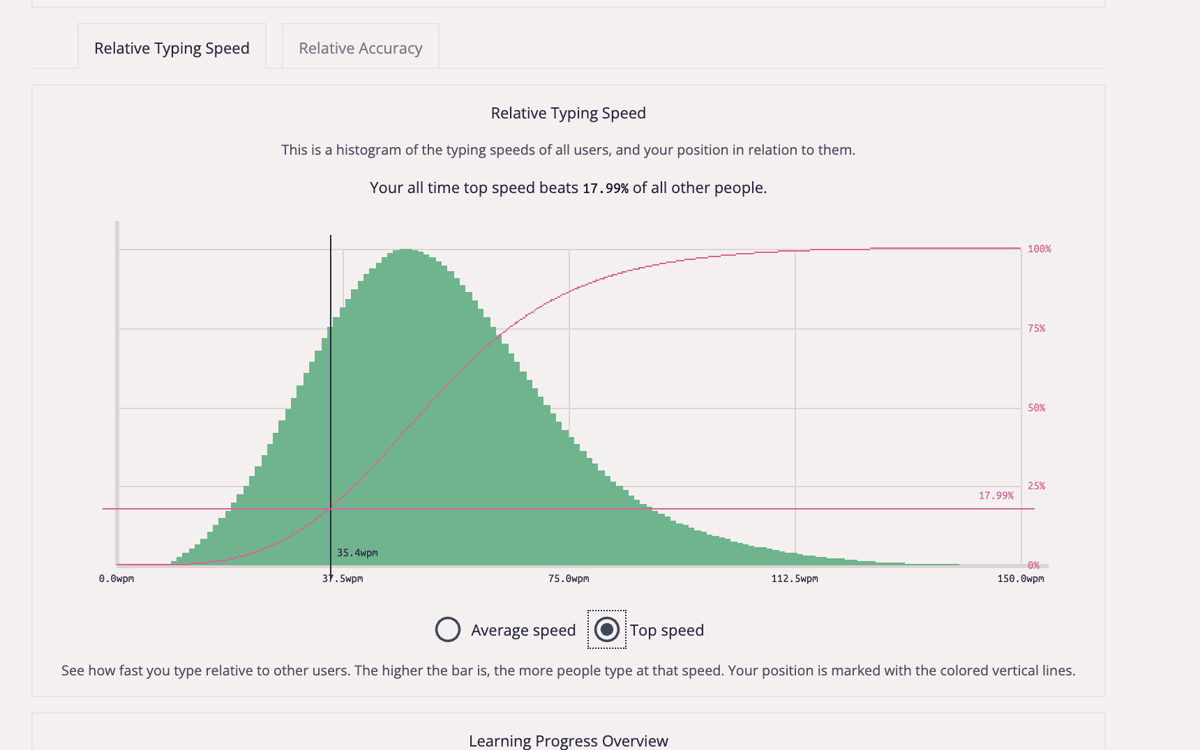
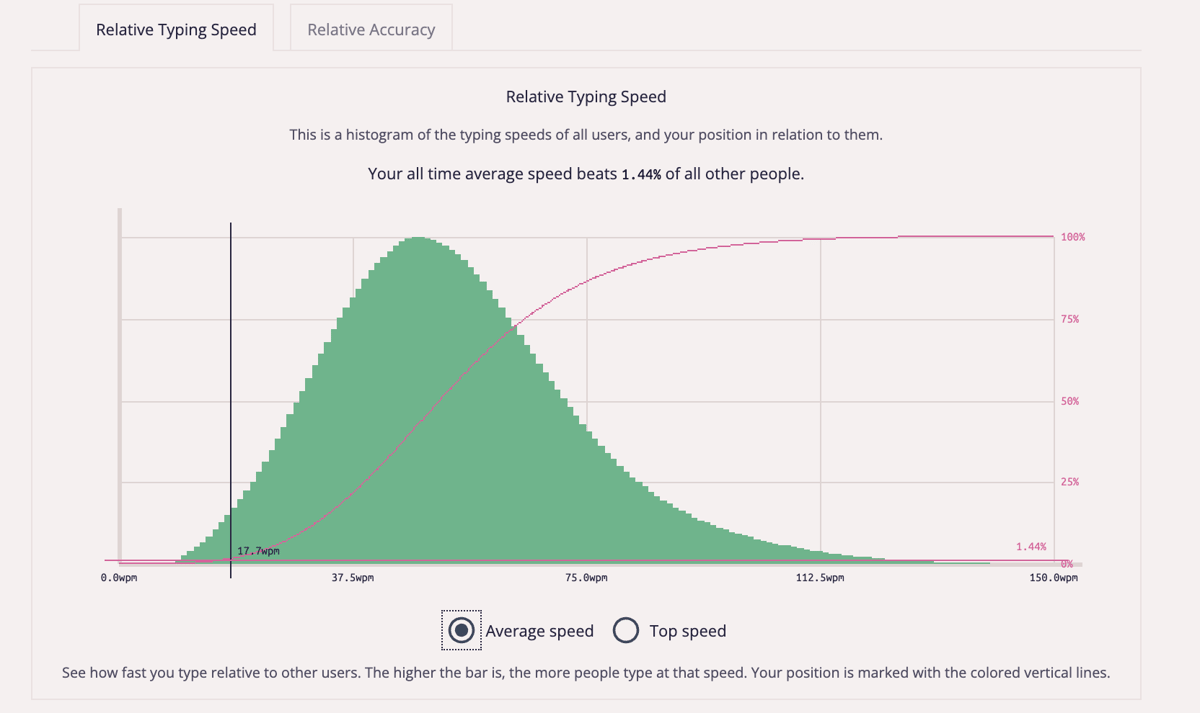
Average speeds are a little more “less impressive”. I’m faster than 1.44% of people, or to put it another way, 98.66% of people are faster than my rather lacklustre 17.4 words per minute.
I’m not training for speed though. I’m training for accuracy at speed.
Accuracy
Going fast is easy. Going fast with high accuracy, that’s harder. Much harder in fact and I learned that lesson playing drums. There’s only one way to speed and accuracy and it’s by going slow and mentally absorbing all of the feelings and sensations mindfully. That’s what I’ve been doing.
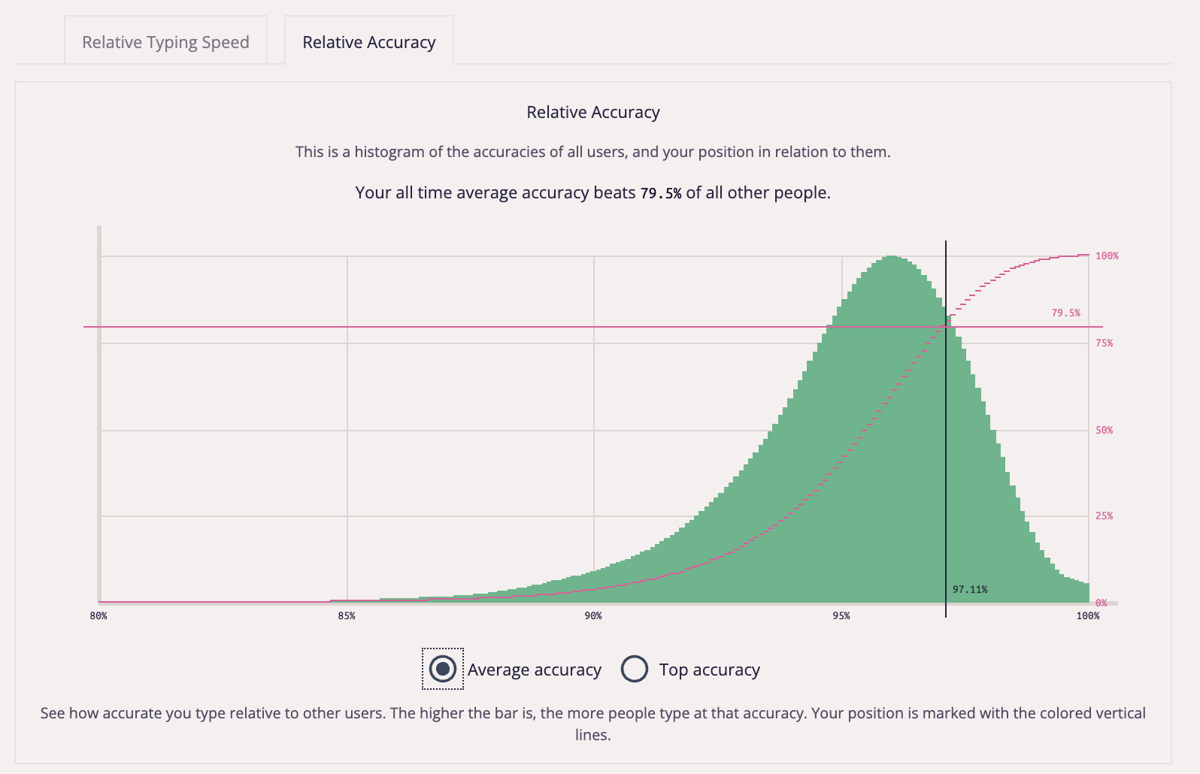
On average I’m more accurate than 79.% of all people. I’ll take that because I’m training accuracy, not speed.
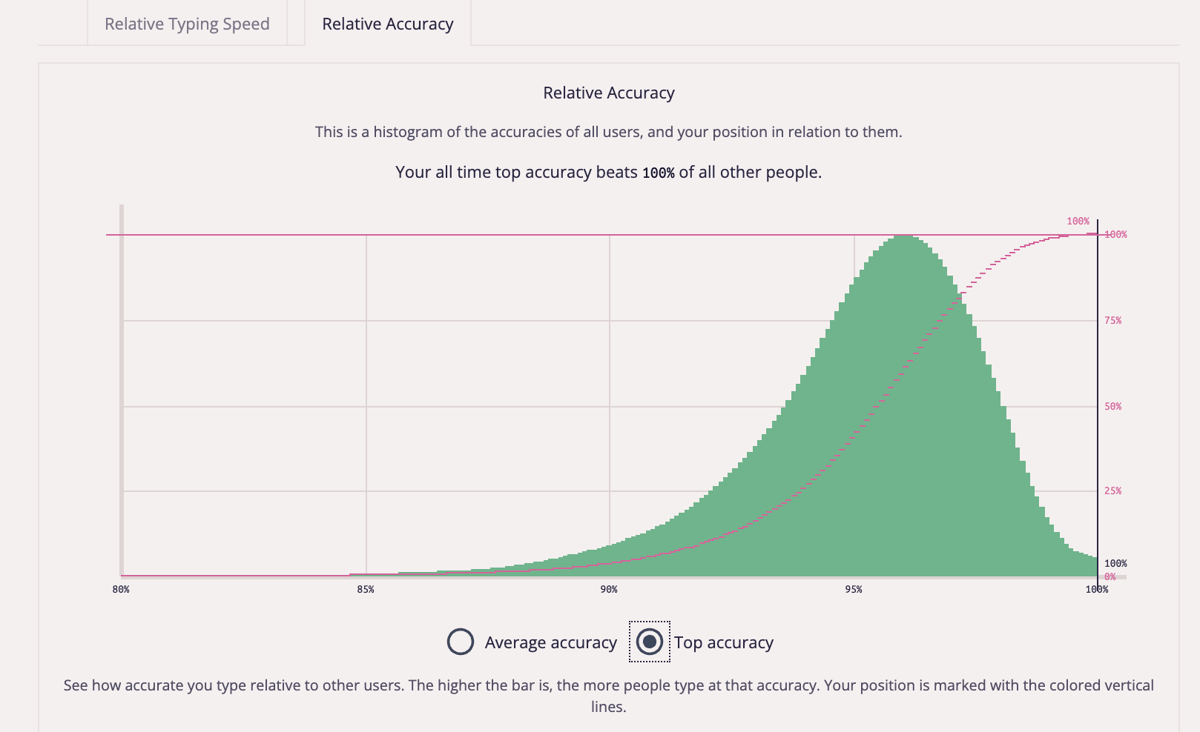
My top accuracy, I’m stoked with that. I beat 100% of people because it’s 100%.
Keybr & Typesati
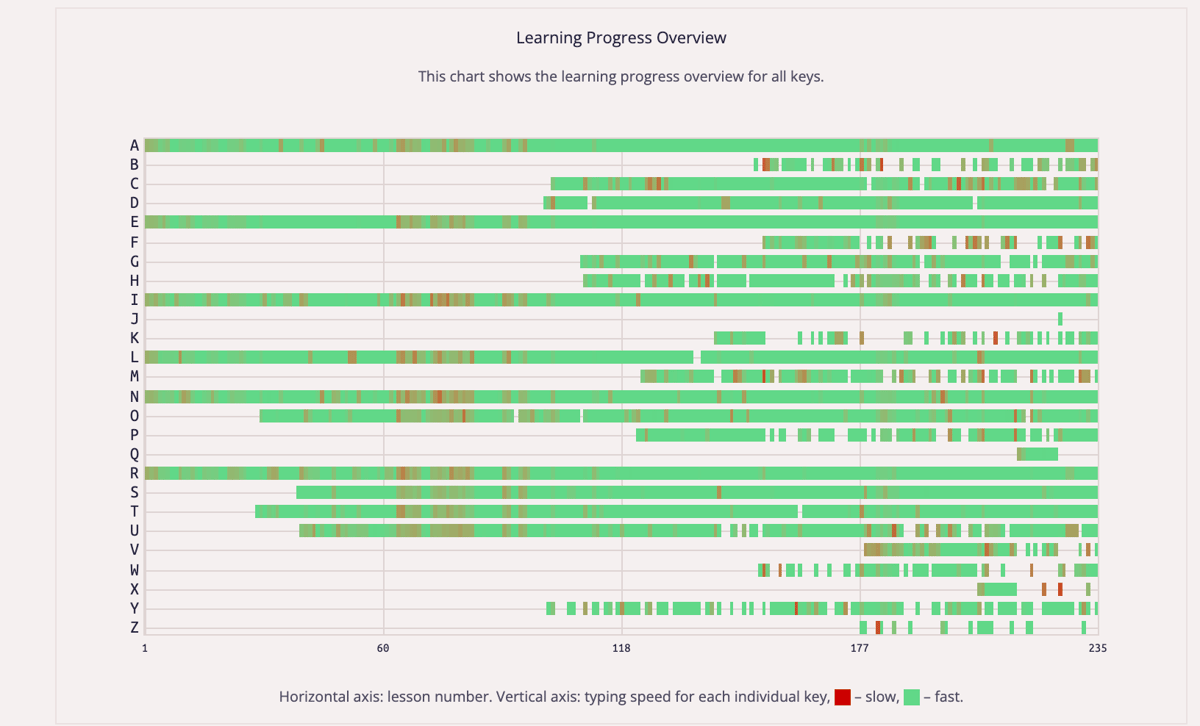
I really like keybr because it trains muscle memory by starting off with limited keys and adding them as accuracy progresses. I’m now accessing the full alphabet and once I’m at a certain speed and accuracy the punctuation will unlock. You can see muscle memory being trained in the below graph. Green are accurate keypresses and red is a miss. Over time there are less misses and more hits.
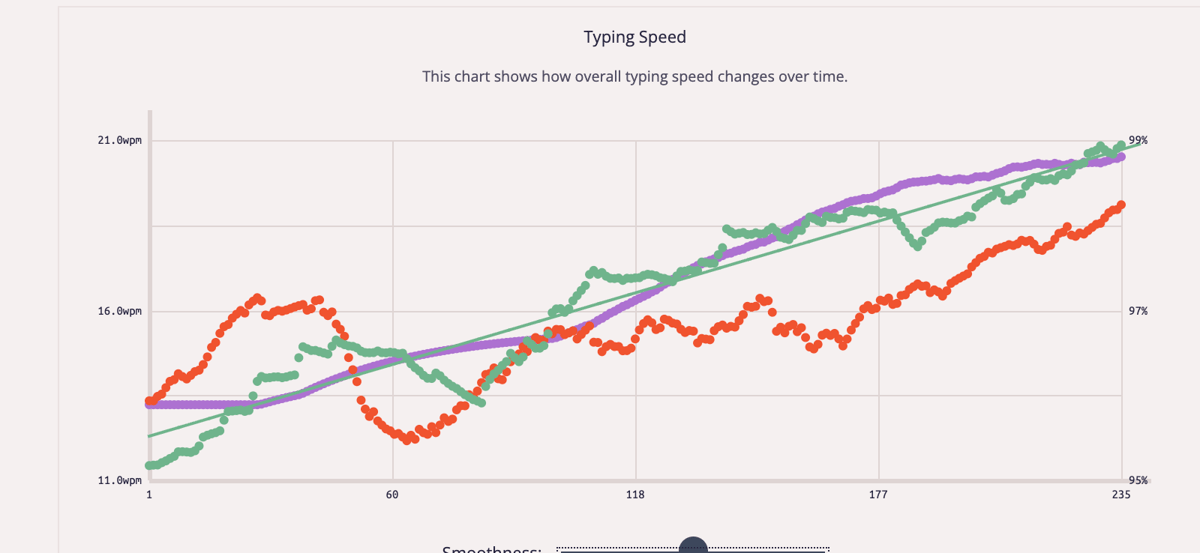
But keybr is formal practice. It’s not for when you’re working and you notice you’re being extra sloppy. That’s why I built Typesati. It captures back spaces presses at the OS level and figures out accuracy based on that. I made the first version of Typesati about twenty one days ago. You can notice the uptick in my accuracy and speed around that point in this keybr graph.
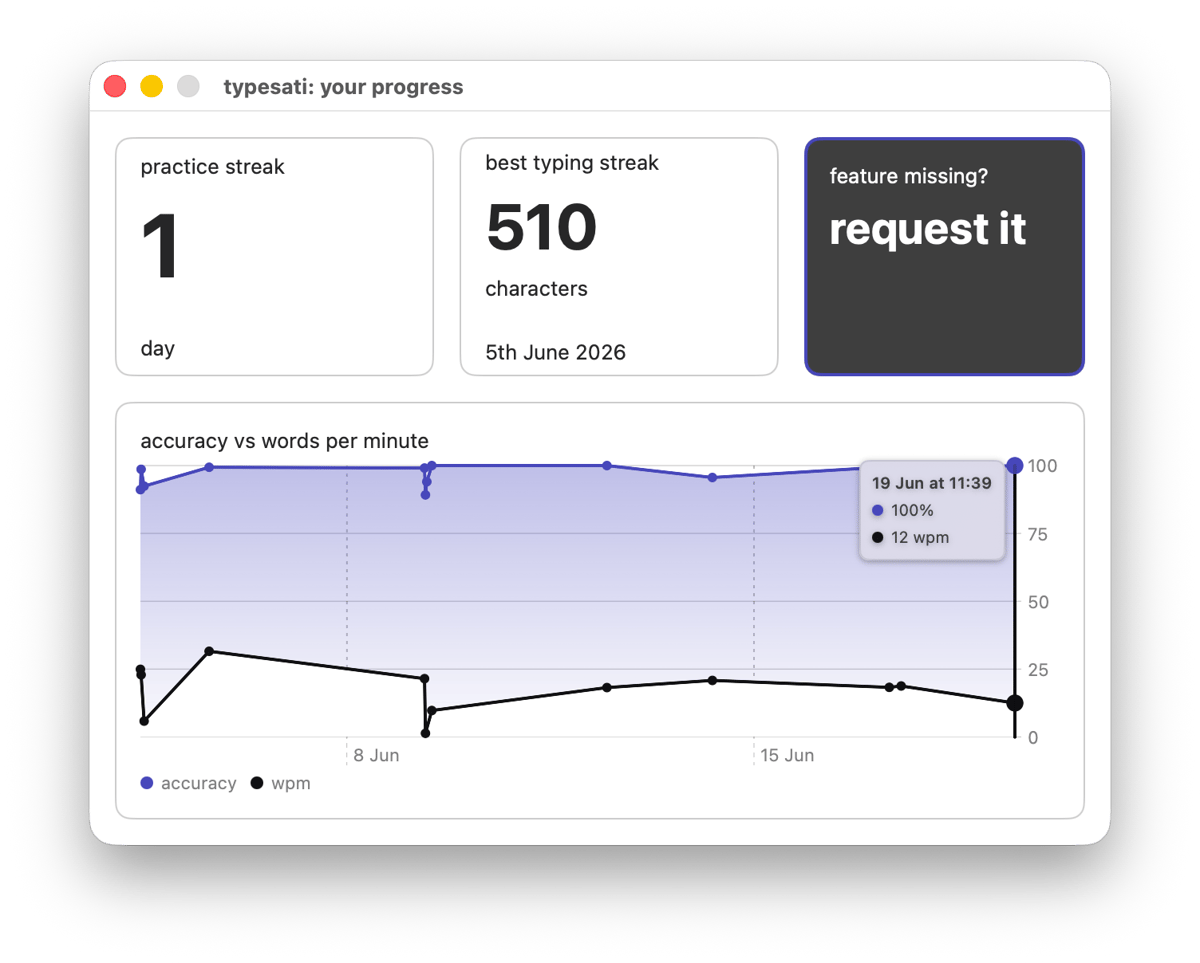
I’ve love to say I’ve been using it daily and maintaining a streak but I have not. I was waiting to see if I needed that prompting built in and I think I do. What is nice to notice though is that my accuracy floats close to 100% when I’m engaged in deliberate practice. The one major difference in how Typesati counts accuracy is that it doesn’t know if you mis-hit a key. It only knows how many times you press backspace. It doesn’t count cmd+ backspace (delete word) or ctrl+backspace (delete line) or other delete sequences (terminal, emacs vim etc) so it’s allows you to train yourself optimally for correction.
Pain?
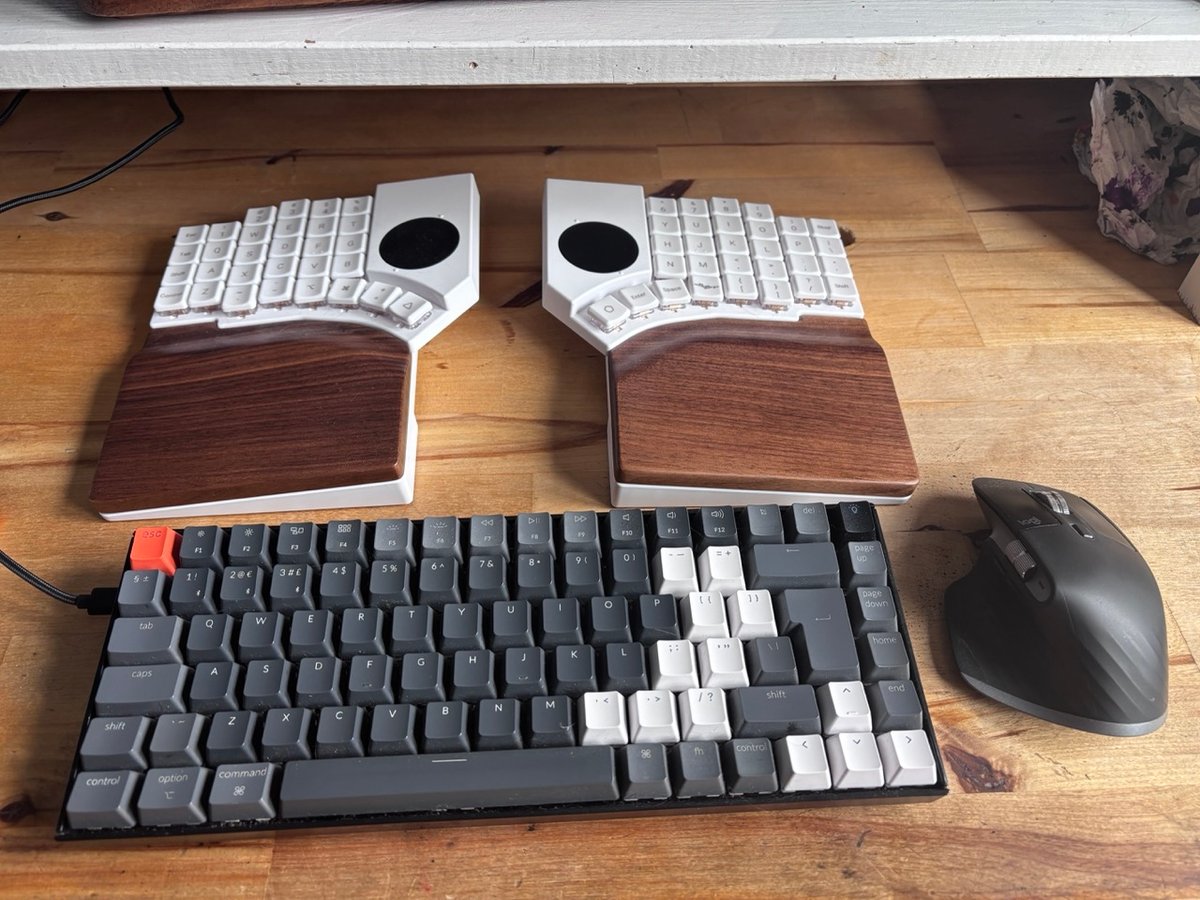
Some but only when using my daily driver – keychron MX2.
I practice on keybr on a Go60 and I don’t have any pain when using that. It’s my intention to move to the Go60 soon. As soon as I can get accurate on the various punctuation required to write Elixir.
Celebrating the small wins.
I’m no where near at the speed I want to be. I’ve seen people think through their fingers and that’s my aim. I’m pretty sure I’ll come on leaps and bounds as an engineer when I’m at that point. It’s really hard when you’re bogged down by your ability to make what’s in your mind happen on the screen. My mind works significantly faster than my fingers can operate at.
But the small wins are important. So after 235 sessions I can say that sometimes, I’m more accurate than 100% of people. Only for a small period and I’m rarely faster than 17% of people. But I’m further along than I’ve ever been and I think this time it is sticking.